Opening the Top Drawer to Mental Computation Module 2

Noticing patterns and relationships

Duration: 60 minutes

Year levels: 2, 2, 2, 3, 3, 3, 4, 4, 4, 5, 5, 5, 6, 6, 6

Category: Algebra, Algebra, Algebra, Arrays, Arrays, Arrays, Counting, Counting, Counting, Number, Number, Number, Number Operations, Number Operations, Number Operations, Number Patterns, Number Patterns, Number Patterns

Proficiency standards: Fluency, Fluency, Fluency, Reasoning, Reasoning, Reasoning, Understanding, Understanding, Understanding

AITSL standards: 1.2 Understand how students learn, 1.2 Understand how students learn, 1.2 Understand how students learn, 2.1 Content and teaching strategies of the teaching area, 2.1 Content and teaching strategies of the teaching area, 2.1 Content and teaching strategies of the teaching area, 2.5 Literacy and numeracy strategies, 2.5 Literacy and numeracy strategies, 2.5 Literacy and numeracy strategies, 3.3 Use teaching strategies, 3.3 Use teaching strategies, 3.3 Use teaching strategies, 6.2 Engage in professional learning and improve practice, 6.2 Engage in professional learning and improve practice, 6.2 Engage in professional learning and improve practice

Use: Groups of Teachers, Groups of Teachers, Groups of Teachers

Teaching practices: Attitudes, Attitudes, Attitudes, Differentiation, Differentiation, Differentiation, Engagement, Engagement, Engagement, Gifted, Gifted, Gifted, Group Work, Group Work, Group Work, Indigenous, Indigenous, Indigenous, Student Learning, Student Learning, Student Learning, Technology, Technology, Technology

Exploring patterns can lead to students generalising relationships. Making connections makes the learning of facts by association easier.

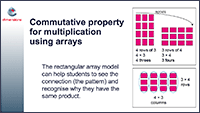
Searching for patterns and relationships helps students to make connections between mathematical ideas and within different contexts. Exploring patterns and relationships leads to generalisation of the properties of the four operations (e.g. using arrays to generalise the commutative property of multiplication). Generalisation is noticing properties that consistently apply and sometimes defining the nature of those properties. The ability to recognise patterns and relationships is a key aspect to developing known facts by association.