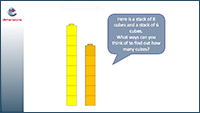
This module is designed to be an introduction to the use of manipulatives and representations to support mental computation in students.
This module introduces the idea that manipulatives are physical objects that can be used as teaching tools to engage students in the hands-on learning of mathematics. They can be used to introduce, practice, or remediate a concept.
In understanding mental load, it is generally accepted that a human brain can hold between five and nine pieces of information in working memory. The use of manipulatives and representations to increase the familiarity of the knowledge needed for the chosen strategy will assist to reduce mental load for students.
Students who calculate mentally are able to visualise problems and work them out in their heads. They need to be provided with appropriate resources that they can use to observe the problem, apply the strategy, and visualise the solution.
Downloads
- Slides: Manipulatives (PPTX 6,086 KB)
- Facilitator Notes: Manipulatives (DOCX 2,760 KB)
- Handout 1: Manipulatives: Mental Methods Moving Along (PDF 156 KB)
- Handout 3: Manipulatives: 1 to 100 grid (PDF 202 KB)
- Handout 4: Manipulatives: Multiplication fact grid (PDF 105 KB)
- Handout 2: Noticing patterns and relationships: Blank multiplication fact grid (PDF 118 KB)