Fraction misconceptions
Duration: 90 minutes
Year levels: 1, 1, 1, 1, 1, 1, 10, 10, 10, 10, 10, 10, 10A, 10A, 10A, 10A, 10A, 10A, 2, 2, 2, 2, 2, 2, 3, 3, 3, 3, 3, 3, 4, 4, 4, 4, 4, 4, 5, 5, 5, 5, 5, 5, 6, 6, 6, 6, 6, 6, 7, 7, 7, 7, 7, 7, 8, 8, 8, 8, 8, 8, 9, 9, 9, 9, 9, 9, Foundation, Foundation, Foundation, Foundation, Foundation, Foundation, Senior, Senior, Senior, Senior, Senior, Senior
Category: Counting, Counting, Counting, Counting, Counting, Counting, Number, Number, Number, Number, Number, Number, Number Operations, Number Operations, Number Operations, Number Operations, Number Operations, Number Operations, Proportions, Proportions, Proportions, Proportions, Proportions, Proportions, Real Numbers, Real Numbers, Real Numbers, Real Numbers, Real Numbers, Real Numbers
Proficiency standards: Fluency, Fluency, Fluency, Fluency, Fluency, Fluency, Understanding, Understanding, Understanding, Understanding, Understanding, Understanding
AITSL standards: 1.2 Understand how students learn, 1.2 Understand how students learn, 1.2 Understand how students learn, 1.2 Understand how students learn, 1.2 Understand how students learn, 1.2 Understand how students learn, 2.1 Content and teaching strategies of the teaching area, 2.1 Content and teaching strategies of the teaching area, 2.1 Content and teaching strategies of the teaching area, 2.1 Content and teaching strategies of the teaching area, 2.1 Content and teaching strategies of the teaching area, 2.1 Content and teaching strategies of the teaching area, 2.5 Literacy and numeracy strategies, 2.5 Literacy and numeracy strategies, 2.5 Literacy and numeracy strategies, 2.5 Literacy and numeracy strategies, 2.5 Literacy and numeracy strategies, 2.5 Literacy and numeracy strategies, 5.1 Assess student learning, 5.1 Assess student learning, 5.1 Assess student learning, 5.1 Assess student learning, 5.1 Assess student learning, 5.1 Assess student learning, 6.2 Engage in professional learning and improve practice, 6.2 Engage in professional learning and improve practice, 6.2 Engage in professional learning and improve practice, 6.2 Engage in professional learning and improve practice, 6.2 Engage in professional learning and improve practice, 6.2 Engage in professional learning and improve practice
Use: Groups of Teachers, Groups of Teachers, Groups of Teachers, Groups of Teachers, Groups of Teachers, Groups of Teachers
Teaching practices: Attitudes, Attitudes, Attitudes, Attitudes, Attitudes, Attitudes, Differentiation, Differentiation, Differentiation, Differentiation, Differentiation, Differentiation, Engagement, Engagement, Engagement, Engagement, Engagement, Engagement, Group Work, Group Work, Group Work, Group Work, Group Work, Group Work, Planning, Planning, Planning, Planning, Planning, Planning, Student Learning, Student Learning, Student Learning, Student Learning, Student Learning, Student Learning
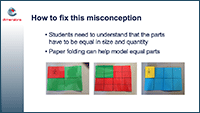
Module 2 addresses four common misconceptions that students can develop: seeing the number of parts only, fractions as a double count, different wholes when comparing, and using rules blindly. The module provides ideas and activities to address these misunderstandings.
Module 2 provides a number of teacher activities to understand and identify student misconceptions. The module provides teaching suggestions to prevent these misconceptions from developing, and also tips on how to fix those that already may have occurred.
Downloads
- Slides: Fraction misconceptions (PPTX 3,371 KB)
- Facilitator Notes: Fraction misconceptions (DOCX 149 KB)
Related modules
- https://dmn.aamt.edu.au/learning-modules/opening-the-top-drawer-to-fractions/opening-the-top-drawer-to-fractions-module-1/
- https://dmn.aamt.edu.au/learning-modules/opening-the-top-drawer-to-fractions/
- https://dmn.aamt.edu.au/learning-modules/opening-the-top-drawer-to-fractions/opening-the-top-drawer-to-fractions-module-3/
- https://dmn.aamt.edu.au/learning-modules/opening-the-top-drawer-to-fractions/
- https://dmn.aamt.edu.au/learning-modules/opening-the-top-drawer-to-fractions/opening-the-top-drawer-to-fractions-module-4/
- https://dmn.aamt.edu.au/learning-modules/opening-the-top-drawer-to-fractions/
- https://dmn.aamt.edu.au/learning-modules/opening-the-top-drawer-to-fractions/opening-the-top-drawer-to-fractions-module-5/
- https://dmn.aamt.edu.au/learning-modules/opening-the-top-drawer-to-fractions/
- https://dmn.aamt.edu.au/learning-modules/opening-the-top-drawer-to-fractions/opening-the-top-drawer-to-fractions-module-6/
- https://dmn.aamt.edu.au/learning-modules/opening-the-top-drawer-to-fractions/